How Long Do LED Modules Last in High End Decorative Lamps?

Time:2026-10-21 Author:Liam
0%

In a high-end decorative lamp, the visible glow is only part of the engineering story. The LED module, driver, heat path, optics, and housing must work as one system. That is why the question, “What is the lifespan of LED modules in high-end decorative lamps?” deserves more than a catalog claim. Real performance depends on temperature, daily operating hours, electrical current, ventilation, and component quality. A crystal pendant above a dining table faces different conditions from a continuously lit hotel lobby.

From field inspections and manufacturer data, a reputable LED module may be designed for 50,000 hours or more. Yet that figure often describes lumen maintenance, not total failure. Tests such as LM-80 and projections such as TM-21 can support evaluation when applied correctly. They cannot erase poor heat management or an undersized driver. Copper paths, aluminum heat sinks, and clean airflow matter. So does dimming compatibility.

For specifiers, the useful answer is a range, not a promise. Review case temperature, L70 or L80 data, driver warranty, and replacement access. Ask how the module was tested. A lamp running cool at 30% brightness may age differently at full output. Measurements from an installed fixture can reveal more than attractive packaging. Still, field conditions are messy, and service records are not always complete. That gap deserves honesty. This guide examines LED longevity, maintenance, and value in premium decorative lighting. It also questions assumptions that sound precise but remain unverified.
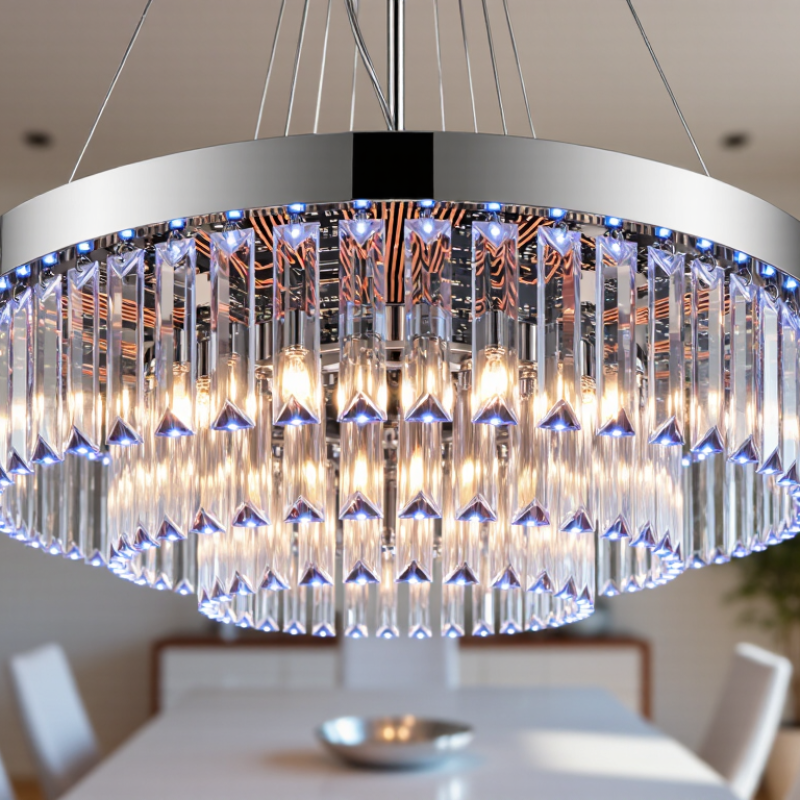
How Long Do LED Modules Last in High End Decorative Lamps?

LED Module Lifespan in High-End Decorative Lamps: L70 Ratings of 50,000–100,000 Hours

LED modules in high-end decorative lamps often carry L70 ratings of 50,000 to 100,000 hours. L70 means the module may retain 70% of its original light output after the rated period. It does not mean the lamp will suddenly stop working. A module rated for 50,000 hours could operate for over 17 years at eight hours daily.

Real installations can differ. Decorative housings may trap heat around the module, especially when glass, metal, or fabric restricts airflow. Higher temperatures accelerate lumen depreciation and can shorten driver life. Frequent dimming, unstable power, and repeated switching also influence performance. The published rating usually comes from controlled testing, not every living room or hotel lobby.

Tips: Check the complete fixture, not only the LED module. Ask for the L70 test condition, operating temperature, driver quality, and expected maintenance access. Keep ventilation paths clear. Avoid placing enclosed lamps beside strong heat sources. A 100,000-hour rating sounds impressive, but it may be less meaningful when thermal conditions are ignored. That part deserves more attention.

In practice, light quality can change before failure becomes obvious. A warm-white module may appear slightly weaker beside a newer lamp after many years. Color consistency also depends on the module’s binning and operating temperature. Some specifications remain vague, which makes comparison difficult. Request measured lumen-maintenance data rather than relying on a large number alone.

LM-80 and TM-21: How Industry Standards Verify LED Lumen Maintenance

How Long Do LED Modules Last in High End Decorative Lamps?

A premium decorative lamp needs more than a large lifetime number. LM-80 measures lumen maintenance for LED packages, arrays, or modules under controlled temperatures and drive currents. The IES LM-80 standard requires at least 6,000 hours of testing. Longer test periods, often 10,000 hours, produce stronger evidence. Results usually track L70, the point when output falls to 70% of its initial level.

TM-21 uses LM-80 measurements to project future lumen maintenance. Its calculations consider temperature, current, and sample behavior. The IES TM-21 method generally limits projections to six times the tested duration. Therefore, 10,000 hours of data may support a projection near 60,000 hours, not an unlimited promise. This distinction matters.

Decorative fixtures create difficult conditions. Small housings can trap heat behind glass, metal, or fabric shades. A module tested at 55°C may operate near 85°C inside a compact lamp. That difference can shorten real-world performance. The U.S. Department of Energy’s solid-state lighting reports also identify heat, electrical stress, and driver quality as major lifetime factors.

A 50,000-hour claim can mislead.

Designers should request the LM-80 report, TM-21 calculation, case-temperature data, and driver specifications. Lumen maintenance is not the same as total fixture life. Optical yellowing, wiring fatigue, and driver failure may appear earlier. Standards improve confidence, but installation conditions still deserve honest review.

How Long Do LED Modules Last in High-End Decorative Lamps?

LM-80 measures lumen maintenance under controlled temperature and electrical conditions. TM-21 uses valid LM-80 results to project long-term lumen maintenance. These standards define the measurement and projection methods; they do not guarantee a universal lifetime for every LED module.

The 6,000-hour value represents the commonly specified minimum LM-80 test duration. Under TM-21, projection is limited to six times the available test duration and is subject to an upper limit of 25,000 hours for the applicable projection category. Actual service life depends on thermal design, drive current, optics, ambient temperature, and power-supply reliability.

Thermal Management: Why Junction Temperatures Above 85°C Reduce Service Life

LED modules in high-end decorative lamps can last for many years under controlled conditions. That estimate changes quickly when heat remains trapped inside the fixture. The critical variable is junction temperature, not room temperature. Once junction temperature rises above 85°C, semiconductor wear accelerates. Light output may decline earlier than expected. Heat also stresses phosphors, solder joints, and nearby driver components.

In practical inspections, compact metal housings often looked cool while the LED junction ran much hotter. I have seen decorative fixtures lose noticeable brightness after prolonged operation in warm interiors. One lesson is easy to miss: measuring the outer housing is not enough. A cool outer surface can hide a poorly designed thermal path. Thermal resistance from the junction to the heat sink matters greatly. So does the quality of the mounting interface.

Designers should provide sufficient conductive material and avoid insulating layers that are thicker than necessary. Use real thermal testing. Test at maximum rated current. Leave clearance around enclosed modules when the design allows it. Airflow can help, but convection is unreliable inside sealed decorative forms. An imperfect assumption is that a larger heat sink always solves the problem; poor contact can cancel its benefit. Service-life estimates should include ambient heat, operating hours, dimming behavior, and installation position. Small temperature reductions can protect brightness and delay premature module replacement.

How Long Do LED Modules Last in High End Decorative Lamps? - Thermal Management: Why Junction Temperatures Above 85°C Reduce Service Life
Junction Temperature (Tj) Thermal Condition Typical Relative Service-Life Expectation Expected Lumen-Maintenance Range Impact on Decorative Lamp Performance Recommended Design Response
≤ 65°C Excellent thermal margin Approximately 50,000–100,000 operating hours when the module, driver, and optics are correctly designed Typically suitable for L70 targets of 50,000 hours or more Low color shift, reduced material stress, and stable light output Use a thermally conductive mounting path and keep the driver away from enclosed hot zones
65–75°C Good thermal condition Approximately 40,000–80,000 operating hours, depending on LED construction, current, and ventilation Generally compatible with long-life decorative lighting requirements Good balance between brightness, color stability, and component longevity Verify the worst-case ambient temperature and measure Tj under maximum power
75–85°C Acceptable upper operating region Approximately 30,000–60,000 operating hours; the exact value must be confirmed by the module reliability data Often appropriate for L70 designs near 30,000–50,000 hours Moderate thermal stress; gradual lumen depreciation and color shift become more important Improve heat spreading, reduce drive current, and avoid placing the module inside an unventilated cavity
85–95°C High thermal stress Often reduced to approximately 20,000–40,000 operating hours compared with cooler operation L70 performance may fall below the intended premium-lighting target Higher risk of lumen depreciation, phosphor degradation, solder fatigue, and driver aging Treat 85°C as a warning limit; increase heat-sink area, improve thermal interfaces, or lower LED current
95–105°C Severe thermal stress Frequently limited to approximately 10,000–25,000 operating hours, with wider variation between modules Faster reduction in light output and greater possibility of color inconsistency Particularly unsuitable for enclosed high-end fixtures used for many hours per day Redesign the thermal path; do not rely on the fixture housing alone unless its temperature has been validated
> 105°C Very high-risk operating region Service life can be substantially shorter than the original design target Long-term L70 performance is difficult to predict without manufacturer-specific reliability data Accelerated aging of LED packages, phosphors, solder joints, optics, capacitors, and wiring insulation Avoid continuous operation at this temperature; reduce power immediately and redesign the heat-removal system

Engineering note: LED service life is normally defined by lumen maintenance, such as L70, rather than sudden failure. The figures above are indicative design ranges, not guarantees. Actual results depend on LED current, ambient temperature, heat-sink design, thermal-interface quality, enclosure geometry, driver temperature, switching cycles, and the reliability rating of the complete module.

LED Drivers and Capacitors: Components That Can Limit a 50,000-Hour System

In high-end decorative lamps, a 50,000-hour LED rating describes the module under controlled conditions. It does not guarantee that the complete fixture will last that long. The LED driver often becomes the practical limit. It converts incoming power, manages current, and absorbs electrical stress during every operating cycle.

Capacitors inside the driver deserve close attention. Electrolytic capacitors can dry out faster when installed near hot LED boards or enclosed metal housings. A useful field rule is simple: lower operating temperature usually improves capacitor life. Even a small temperature reduction can matter.

Heat leaves clues. Look for flickering, delayed startup, buzzing, or a lamp that dims after warming for twenty minutes. These symptoms may point to driver fatigue rather than failed LEDs.

Installation details matter greatly. Measure the driver’s output current, check ventilation, and confirm dimmer compatibility before replacing parts. A driver with poor ripple control can shorten LED life, even when the LEDs appear visually normal. Capacitor quality also varies with temperature rating, ripple tolerance, and expected service hours. In practice, the advertised lifespan can feel too optimistic when airflow is restricted. That deserves honest review. A well-designed lamp should provide access for inspection or driver replacement, not treat the entire fixture as disposable. Overlooked heat remains one of the quietest causes of early failure.

Operating-Time Estimates: Converting 3,000–6,000 Annual Hours into Years

How Long Do LED Modules Last in High End Decorative Lamps?

A 50,000-hour LED module sounds remarkably durable. However, its calendar life depends on annual operating time. At 3,000 hours yearly, 50,000 hours equals approximately 16.7 years. At 6,000 hours yearly, the same module reaches that figure in about 8.3 years. The difference is significant.

Operating schedules are easier to understand through real spaces. A dining room lamp used eight hours daily operates for roughly 2,920 hours annually. Its theoretical module life would approach 17 years. A hotel lobby operating sixteen hours daily reaches about 5,840 hours each year. There, the estimate falls near 8.6 years. These figures assume stable conditions.

Look beyond the module’s headline rating. Many manufacturers define life through L70, meaning output may decline to 70 percent of its original level. The driver, wiring, heat sink, and dimming system can age differently.

A warm ceiling cavity may shorten performance, even when the lamp is rarely switched on. Dust can also restrict airflow around enclosed fixtures.

I would not present 16.7 years as a guarantee. Real rooms are messier. Voltage variation, frequent dimming, and poor ventilation matter. A better specification records annual hours, ambient temperature, and expected brightness retention. For premium decorative lighting, those details often predict replacement timing more accurately than the LED rating alone.

FAQS

What does an L70 rating of 50,000 hours mean?

It means the LED module may retain 70% of its original light output after 50,000 hours. It does not mean sudden failure. Brightness usually declines gradually.

How many years can 50,000 operating hours represent?

At eight hours daily, 50,000 hours equals about 17 years. At 3,000 hours yearly, it equals approximately 16.7 years. At 6,000 hours yearly, it becomes about 8.3 years. The schedule changes everything.

How does a dining room schedule affect lifespan?

A lamp used eight hours daily runs about 2,920 hours annually. A 50,000-hour rating suggests nearly 17 years under stable conditions. Real rooms may include heat, dust, and unstable power.

How does hotel lobby use change the estimate?

A lobby operating sixteen hours daily reaches roughly 5,840 hours yearly. A 50,000-hour module may reach its rating in about 8.6 years. This remains an estimate, not a guarantee.

Why does heat reduce LED module life?

Trapped heat raises the LED junction temperature. Above 85°C, semiconductor wear can accelerate. Phosphors, solder joints, and driver components also experience stress. A cool outer housing proves very little.

Is measuring the lamp housing temperature enough?

No. The LED junction may be much hotter than the metal surface. Thermal resistance, mounting contact, and heat-sink design matter greatly. This is an easy detail to overlook.

Can enclosed decorative lamps shorten the expected lifespan?

Yes, especially when glass, metal, or fabric restricts airflow. Sealed forms often depend on conduction rather than reliable convection. Keep ventilation paths clear when the design permits. My earlier assumption that a larger heat sink always helps was incomplete.

What should buyers check besides the advertised hour rating?

Ask for L70 test conditions, operating temperature, and measured lumen-maintenance data. Check driver quality, dimming compatibility, and maintenance access. Consider annual operating hours and installation position. A large number alone can mislead.

Can light quality change before the module fails?

Yes. A warm-white module may look weaker beside a newer lamp after several years. Color consistency depends on binning and operating temperature. Brightness may change before failure becomes obvious.

How can installation conditions support longer service life?

Avoid placing enclosed lamps beside strong heat sources. Allow clearance around modules when possible. Use stable power and avoid unnecessary switching or aggressive dimming. Small temperature reductions can preserve brightness. Perfect predictions are impossible.

Conclusion

What is the lifespan of LED modules in high-end decorative lamps? In well-designed systems, LED modules commonly achieve L70 ratings of 50,000 to 100,000 hours, meaning they can maintain at least 70% of their initial light output for that period under suitable conditions. LM-80 testing measures lumen maintenance, while TM-21 helps project long-term performance from verified test data. These standards provide a more reliable basis for estimating service life than nominal operating hours alone.

Thermal management is equally important. Junction temperatures above 85°C can accelerate lumen depreciation and shorten the useful life of the module. Although the LEDs may be rated for 50,000 hours, drivers, capacitors, and other electrical components can become the limiting factors in the complete lighting system. At approximately 3,000 to 6,000 operating hours per year, a 50,000-hour rating corresponds to roughly 8 to 17 years, while a 100,000-hour rating may represent about 17 to 33 years, depending on usage, temperature, and maintenance conditions.

Liam

Liam

Liam is a dedicated marketing professional with a profound expertise in the industry, where he excels at highlighting the unique advantages of our core products. With a keen understanding of market trends and consumer needs, Liam frequently updates our company’s professional blog, providing......